10x10 Custom Pop Up Tent: Size, Uses, and Buying Guide
If you've ever stood in front of a tent-size chart trying to figure out what you actually need, you're not alone. Most people overthink this decision, and honestly, you don't need to. For the vast majority of businesses heading to a trade show, market, or outdoor event for the first time, a 10x10 custom pop up tent is the right call. It's the size almost every venue expects, it's easy to transport, and it gives you enough room to actually run a booth without paying for space you'll never use.
This guide walks through what a 10x10 actually gives you, who it's built for, and what separates a tent that survives years of events from one that falls apart after a single windy afternoon.
What Exactly Is a 10x10 Custom Pop Up Tent?
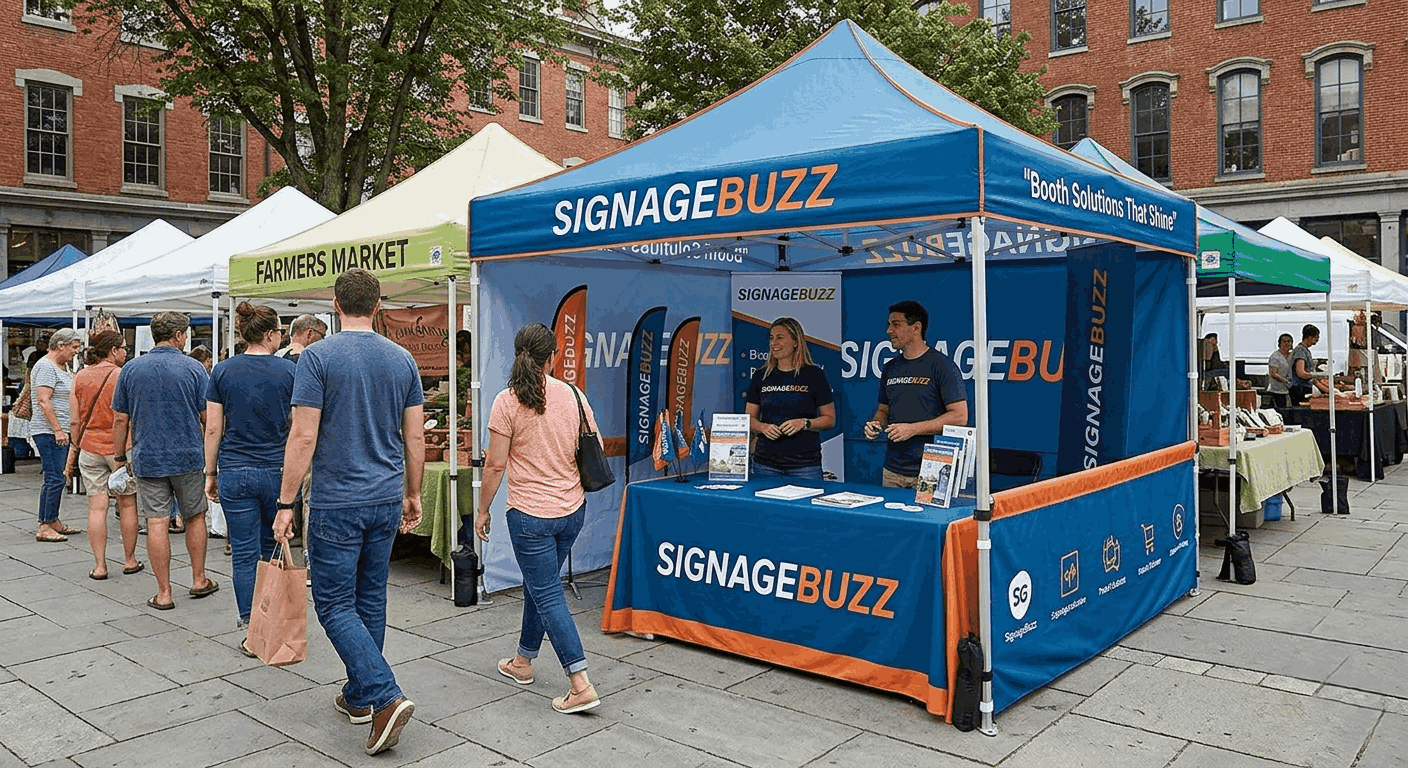
A 10x10 custom pop up tent is exactly what it sounds like: a 10-foot by 10-foot canopy frame, printed with your branding, designed to fold down for transport and pop back up in minutes. That's 100 square feet of covered space — enough for a standard table, your signage, and typically two to four staff members without anyone bumping elbows.
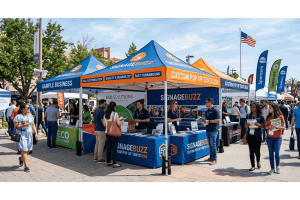
It's also the industry-standard footprint. Most trade shows, street fairs, and farmers markets are built around 10x10 vendor spaces, so if you show up with anything bigger, you might actually be breaking the rules of the venue. Show up with anything smaller, and you'll feel boxed in compared to the booth next to you. The 10x10 sits right in that sweet spot — big enough to look professional, small enough to set up solo if you need to.
If you want to see how it compares to other sizes before committing, SignageBuzz's full custom pop up tents lineup breaks down everything from compact 5x5 setups to massive 20x20 activations.
Who Actually Needs a 10x10 Size
A 10x10 isn't just the "default" option — it genuinely fits more event types than any other size. Here's where it tends to show up most:
- Trade shows and expos. Most convention centers and exhibitor halls are laid out in 10x10 increments, so this size keeps you compliant with venue rules while giving you a full booth's worth of branding space.
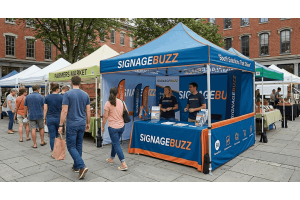
- Farmers markets and weekend vendor fairs. Easy enough for one or two people to haul, set up, and break down without needing a truck or a crew.
- Sidewalk sales and pop-up retail. When you're activating outside your storefront for a weekend promotion, a 10x10 gives you visibility from the street without overwhelming the sidewalk.
- Corporate activations and product launches. Smaller teams running a single demo station or sign-up booth find 10x10 gives them just enough room for a table, a screen, and a couple of brand ambassadors.
- Sports sponsorships and tailgates. Durable enough to survive a full season of weekend setups, and compact enough to fit in a standard vehicle between events.
If your event regularly needs more than a table and two staff — think product displays, demo stations, or seating for client conversations — it's worth looking at a 10x15 or 10x20 instead. But for the overwhelming majority of single-business booths, 10x10 is the right starting point.
What to Look for When Buying a 10x10 Custom Pop Up Tent
This is where a lot of people get burned. Plenty of tents look identical in a product photo, and the difference only shows up after the third or fourth event, when a cheap frame starts bending or the print starts peeling. A few things worth actually checking before you buy:
Frame Quality
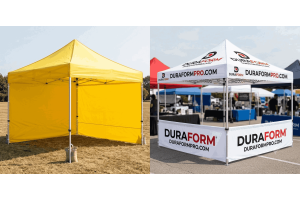
Look for hexagonal aluminum legs over round ones — hexagonal profiles resist the twisting and flex that round legs struggle with in windy conditions. Steel foot plates also matter more than people expect; they're what keeps the whole structure grounded on uneven pavement or grass instead of wobbling with every gust.
Fabric Weight and Finish
A heavier-denier polyester canopy holds up to repeated folding and unfolding without developing creases or weak points. It should also be water-resistant and flame-retardant — not just "water-resistant," which is a much lower bar than fully sealed and waterproof.
Printing Method
Dye sublimation printing bonds ink directly into the fabric instead of sitting on top of it, which is why it resists cracking and fading where screen printing or vinyl decals eventually peel.
Warranty and Guarantee Terms
A tent that's actually built for repeated use should come with a real warranty on the frame and a fade guarantee on the print — not just a return policy for defects on arrival.
Replacement Part Availability
Frames take a beating over a few seasons. If a leg bends or a connector cracks, you want to be able to order that specific part instead of replacing the entire tent.
Custom Pop Up Tents with Logo: Making Your 10x10 Work Harder
A blank 10x10 keeps you dry. A branded one gets you noticed before anyone's close enough to read a table sign. That's really the whole case for custom pop up tents with logo printing — it turns 100 square feet of shelter into 100 square feet of advertising you already own.
The placement matters more than people expect going in:
- Canopy peak — seen from across a parking lot or convention floor.
- Valance — the strip hanging down from the roof edge sits closer to eye level, making it a better spot for a tagline, website URL, or QR code that someone actually has time to read as they walk past.
- Sidewalls — give you a third surface for product imagery or messaging without crowding the top.
The other thing worth knowing: a logo that looks great on a business card doesn't automatically translate to a 10-foot canopy peak. Spacing and scale that work at a few inches can look cramped or off-center stretched across a much larger surface. A decent printer's design team should send you a 3D mockup before anything goes to production, with revisions included, so you're approving exactly what you're going to get — not hoping it works out.
At SignageBuzz, every custom pop up tent with logo includes a free 3D mockup, full-color dye sublimation printing, and Pantone color matching, so the blue on your tent is the same blue as your website and business cards — not a close approximation.
How Much Does a 10x10 Custom Pop Up Tent Cost?
Pricing depends on frame thickness, printing coverage, and whether you're adding sidewalls or accessories, so it's worth comparing full packages rather than just the canopy top alone.
If you're outfitting an entire team or multiple booth locations, it's worth asking about consistency across orders — you want every tent in the fleet to match exactly, not just be "close enough."
Frequently Asked Questions
Is a 10x10 custom pop up tent big enough for a trade show booth?
Yes — it's the standard size most trade shows and exhibitor halls are built around, and it comfortably fits a table, signage, and a couple of staff members.
How long does a custom pop up tent with logo printing last?
With a quality frame and dye-sublimation printing, several years of repeated seasonal use is realistic, especially with a fade guarantee backing the print.
Can I set up a 10x10 custom pop up tent by myself?
Most pop-up frames are designed for a tool-free, two-person setup in a few minutes, though a single person can usually manage it with a bit more time.
Do I need fire certification for my tent?
If you're setting up at a managed venue — convention center, city-permitted event, or stadium — many require NFPA-701 and CPAI-84 fire certification before they'll let you bring a tent onsite.
The Bottom Line
A 10x10 custom pop up tent is the safest, most versatile size for almost any business getting into events, and the difference between a good one and a forgettable one comes down to frame quality, fabric weight, and printing method — not the size itself. If you're ready to see what your logo looks like on one, SignageBuzz offers a free 3D mockup before you commit to anything.
Get Your Free 3D Mockup